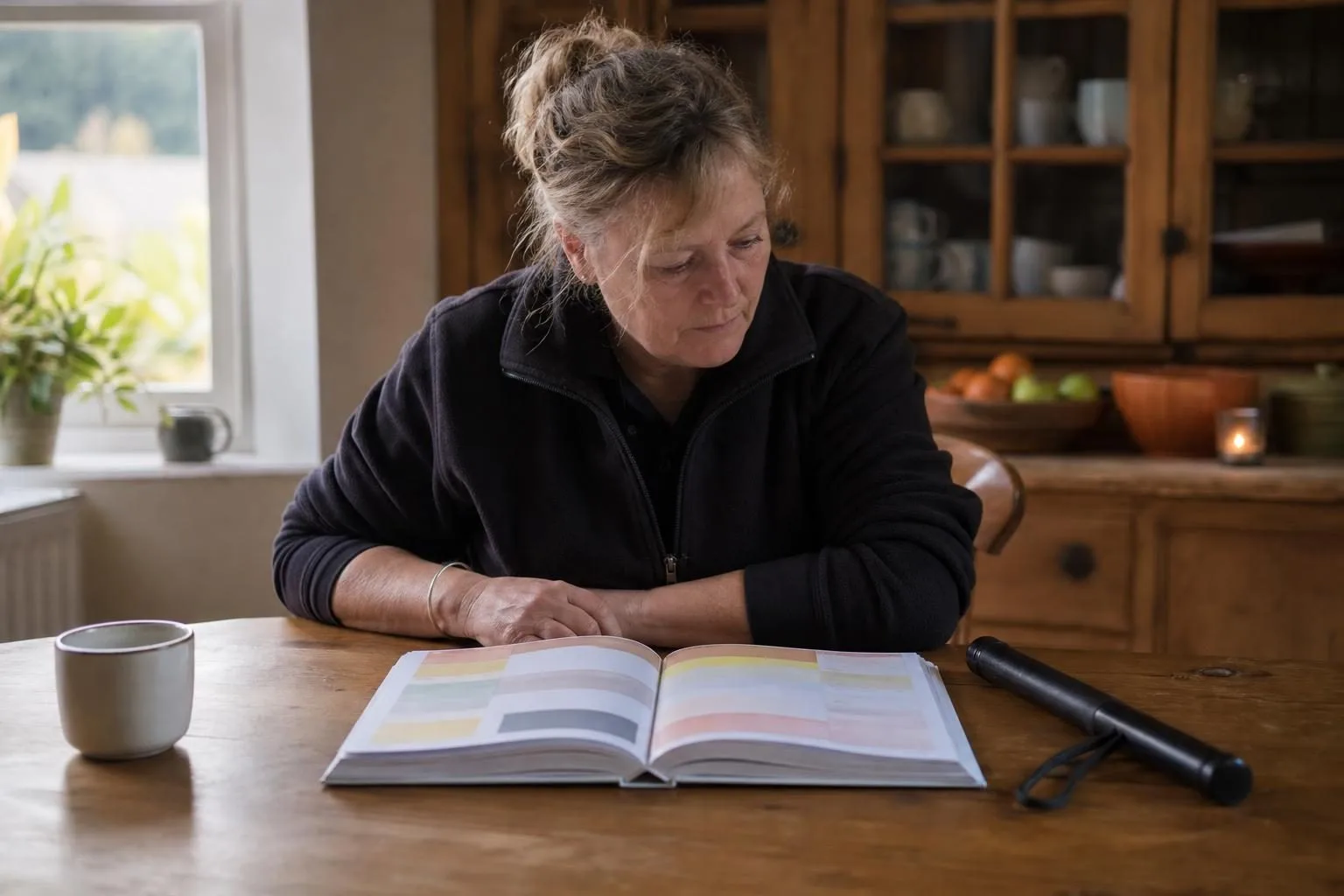
Introductory price — today only

📄 Digital book in PDF: it comes by email. Nothing is shipped on paper.

Door supervisor course booked? Every rule drawn beside its scene at the door

How to understand arrest, force and licensing law without decoding dense legal paragraphs

Get the guide ➤

🔒 Protected checkout · PDF by email · 30-day guarantee

64illustrated pages, one topic each
7parts covering all four units
2free bonus books included
PDFby email, ready to print

Take a look inside the book

Designed to read on your phone screen while you revise between shifts or on the way to the training centre.

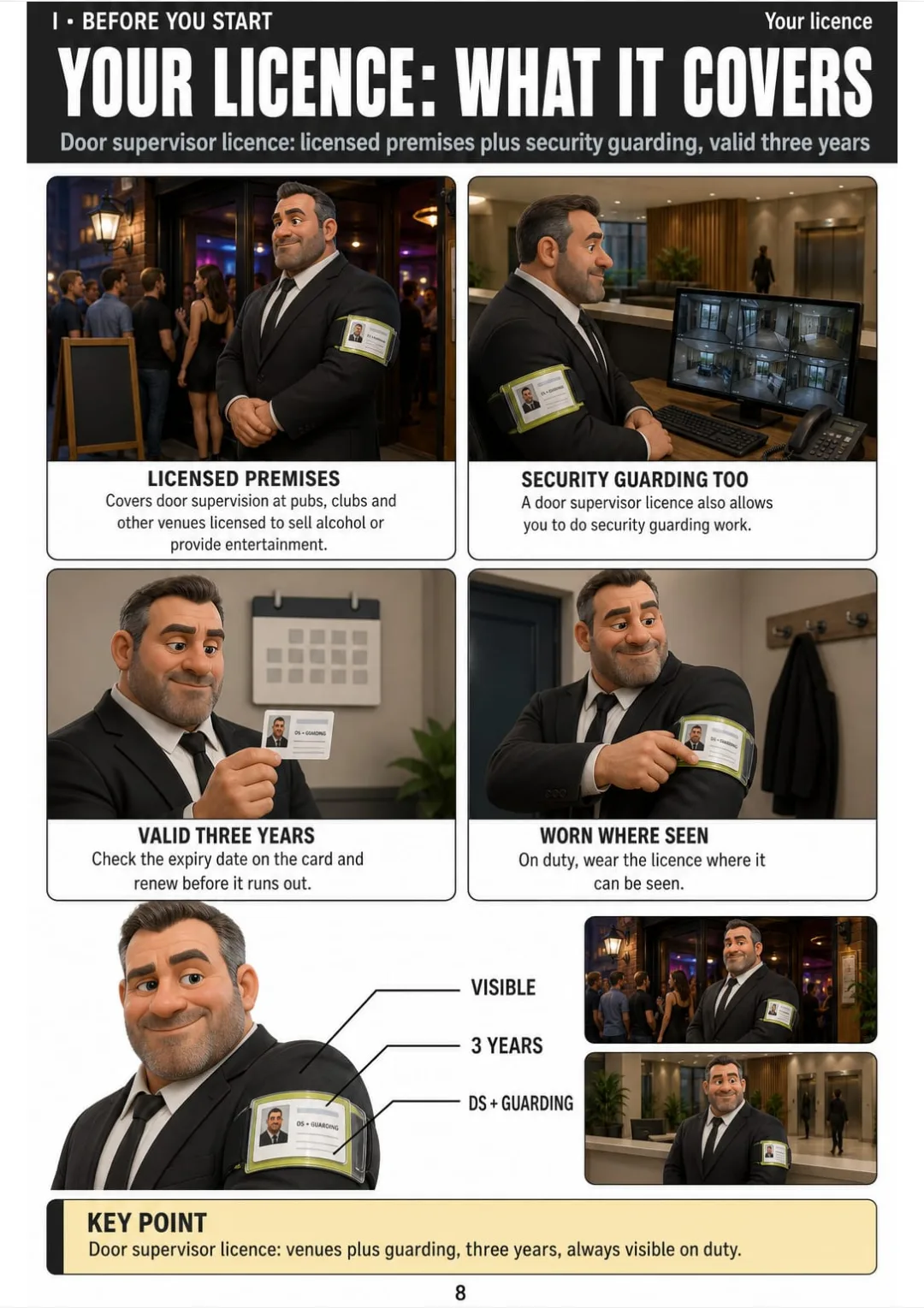
Door supervisor licence: licensed premises + security guarding, valid 3 years, worn visibly.
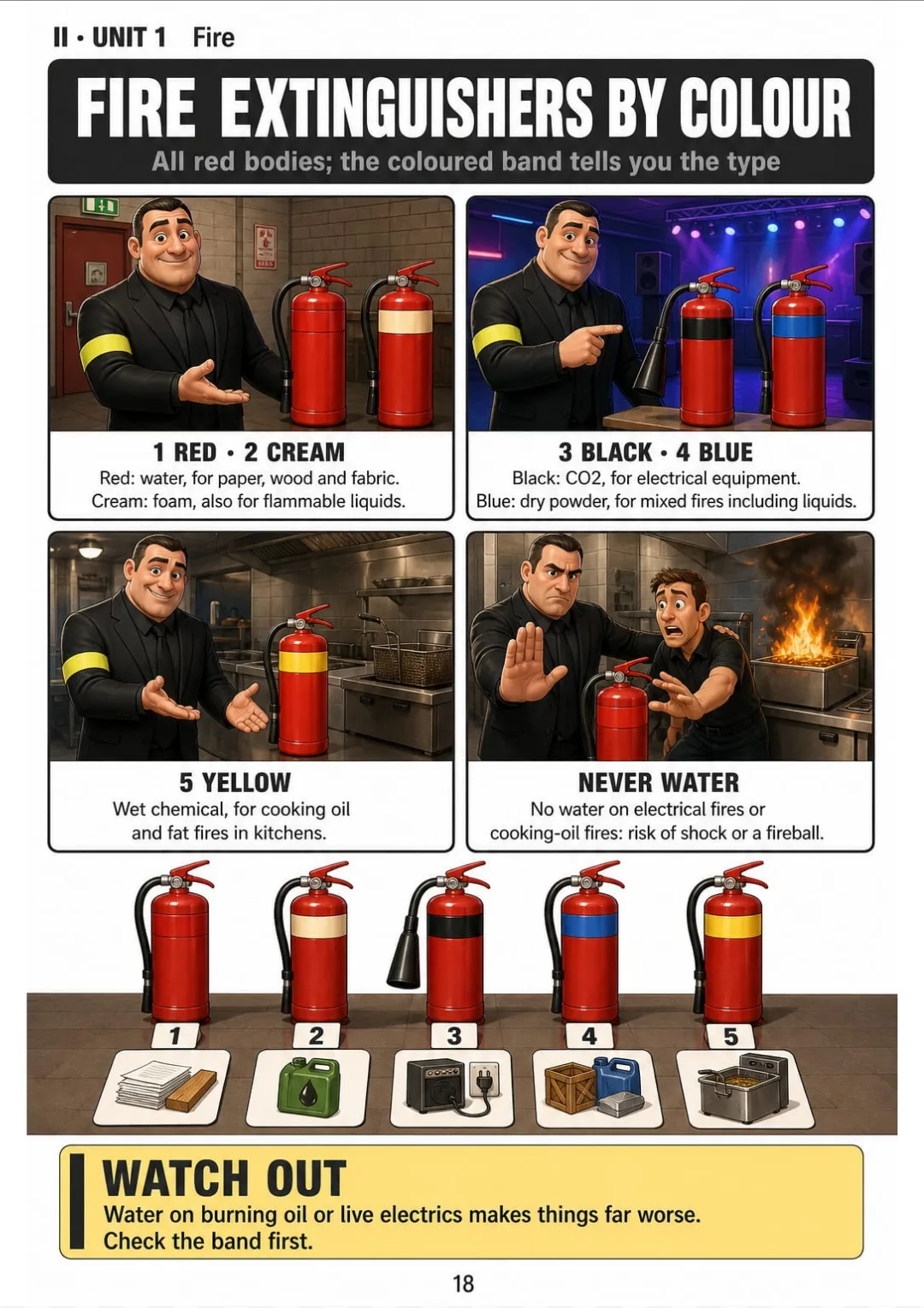
Red water, cream foam, black CO2, blue powder, yellow wet chemical.
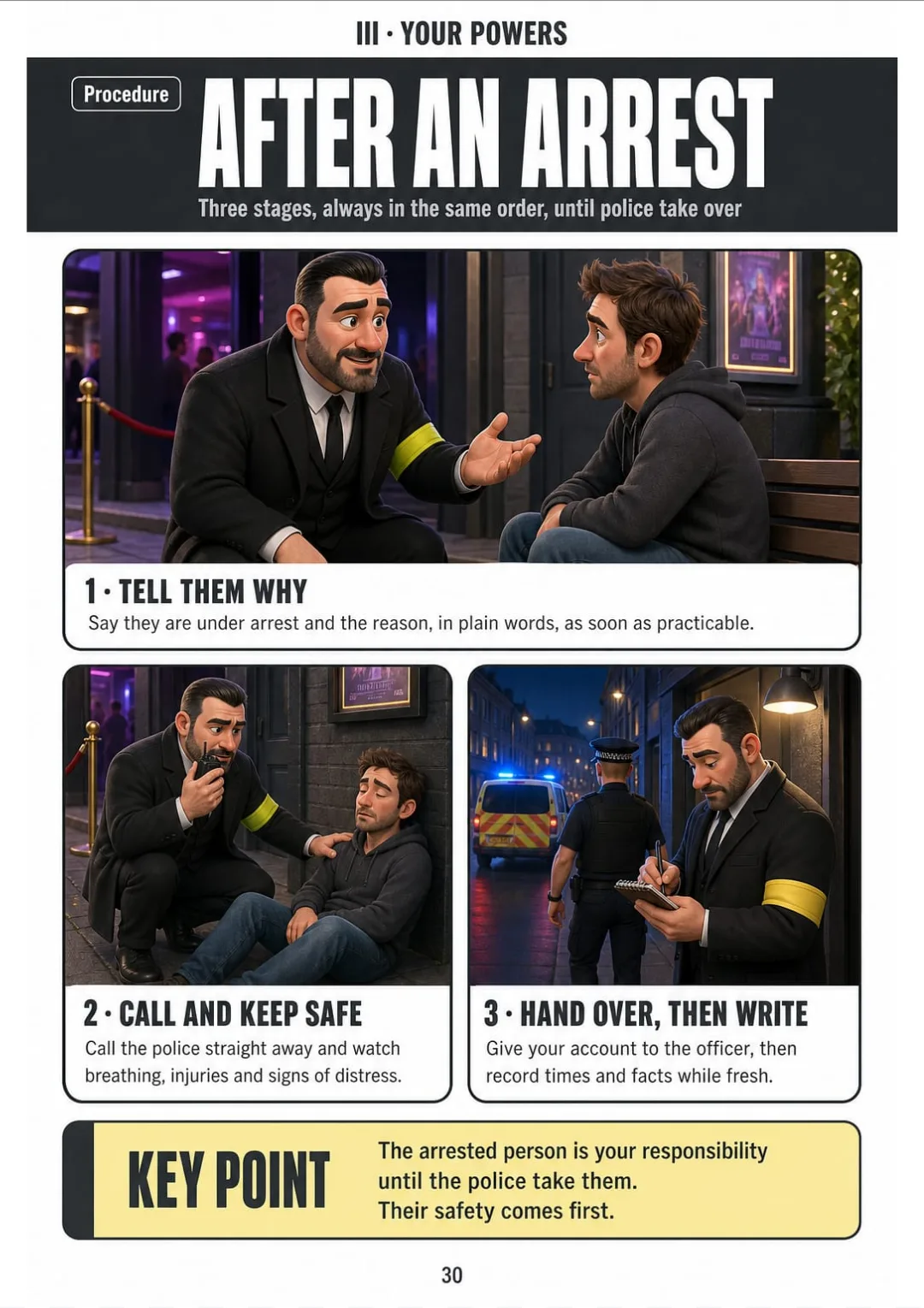
After an arrest: tell them why, call police, keep them safe, hand over, write it up.
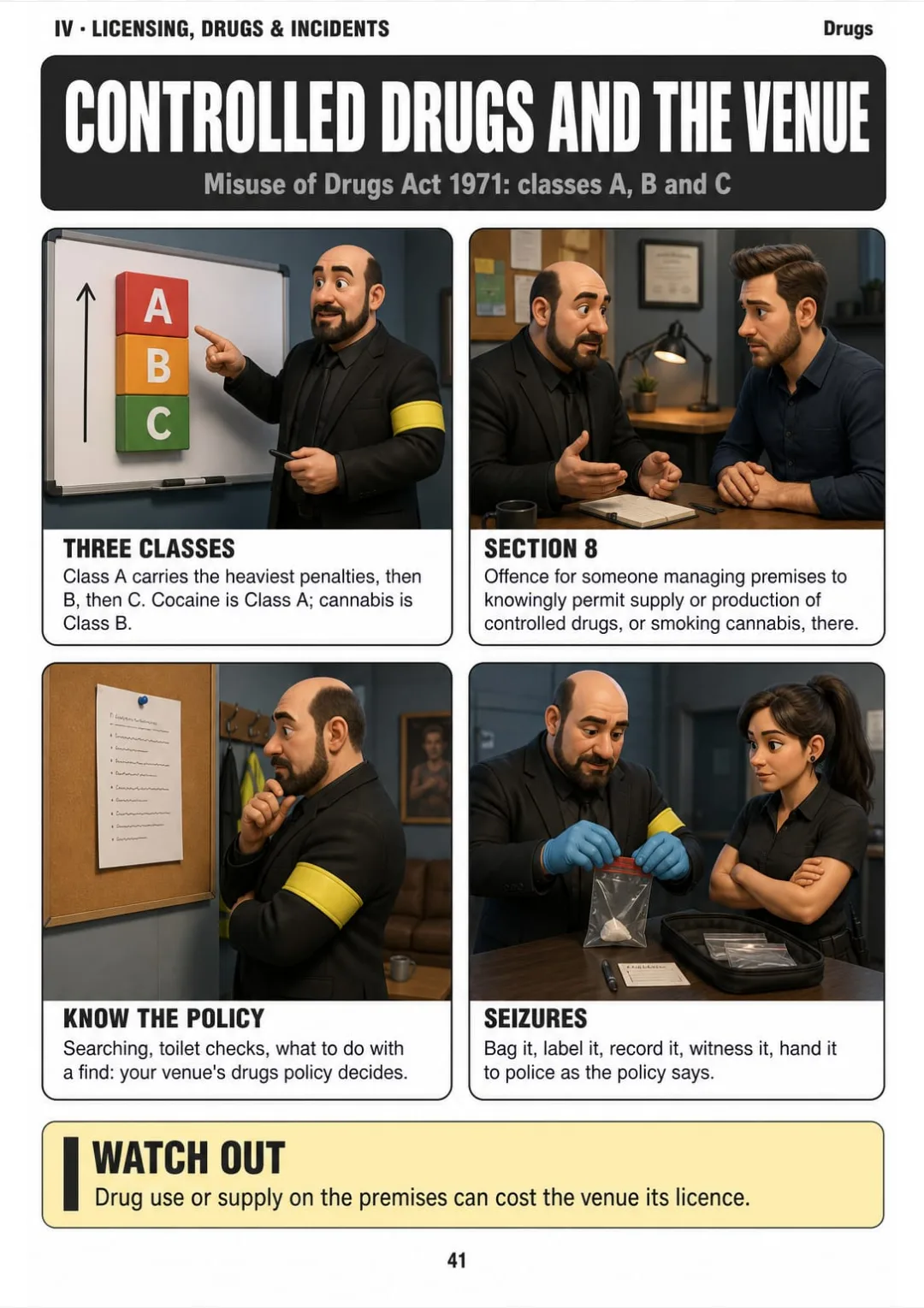
Misuse of Drugs Act 1971: Class A, B, C and how seizures are bagged and logged.
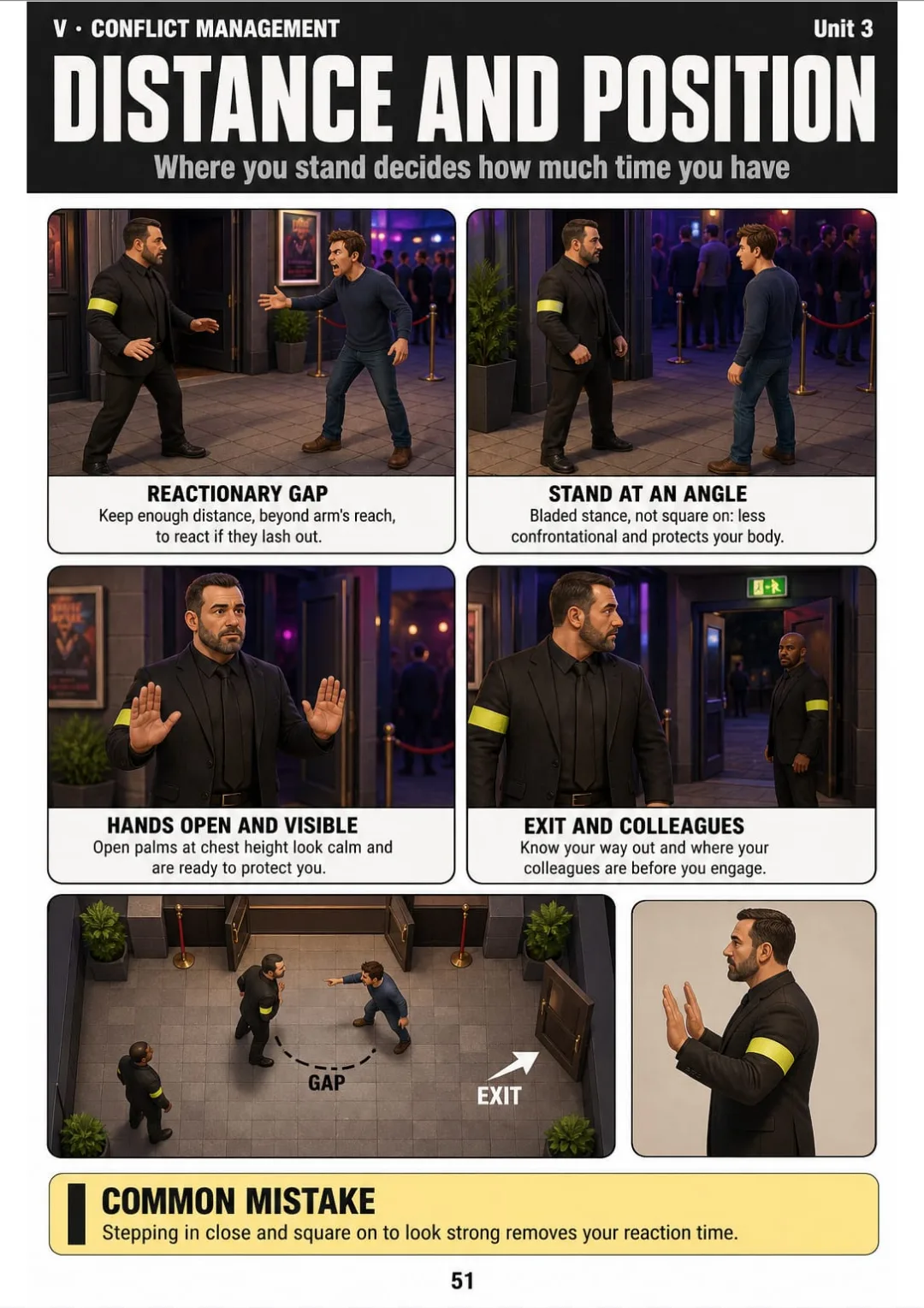
A top-down plan of the door: reactionary gap, angle, open hands and exit.
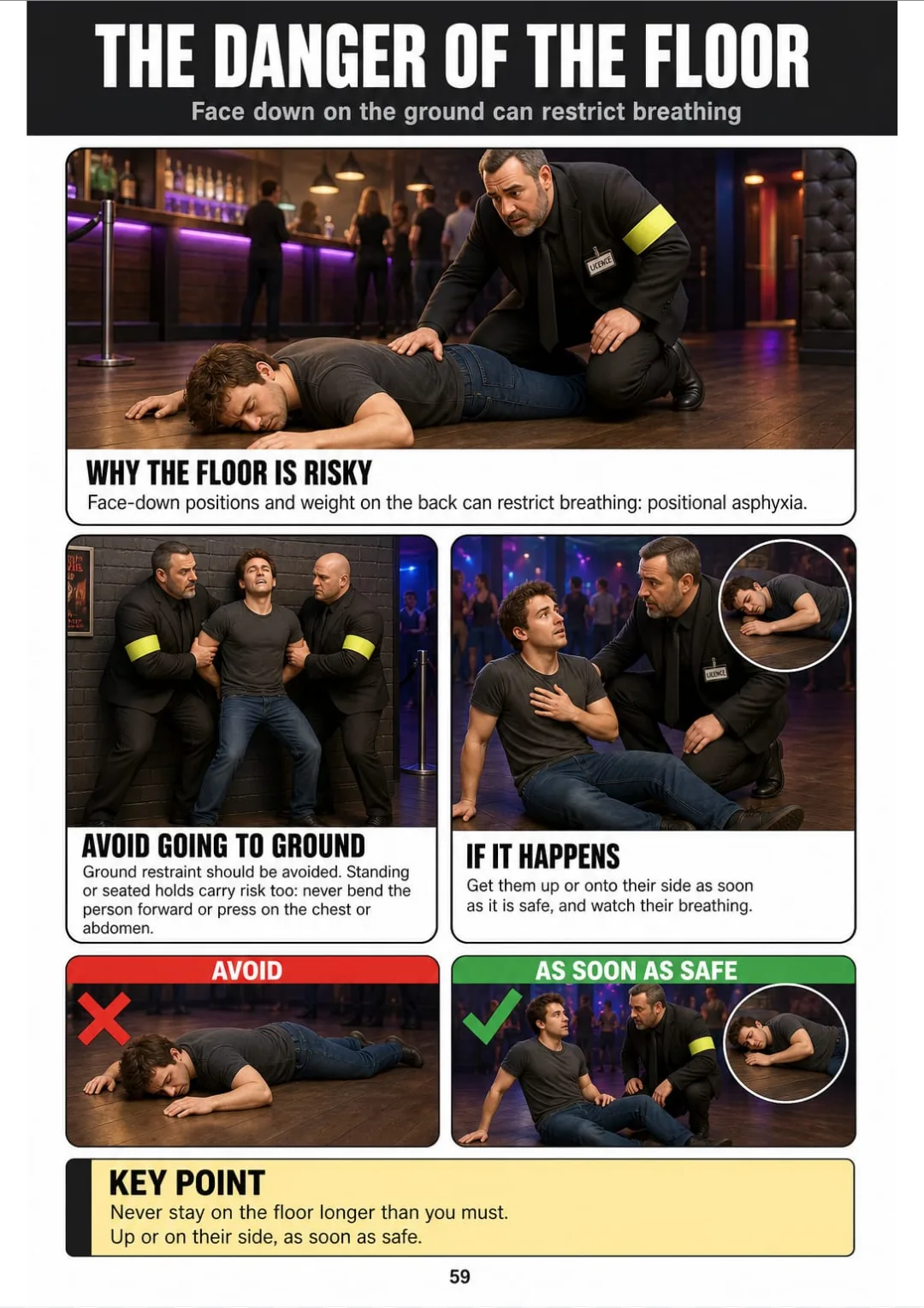
Why face-down restraint is dangerous and what to do if someone ends up on the floor.
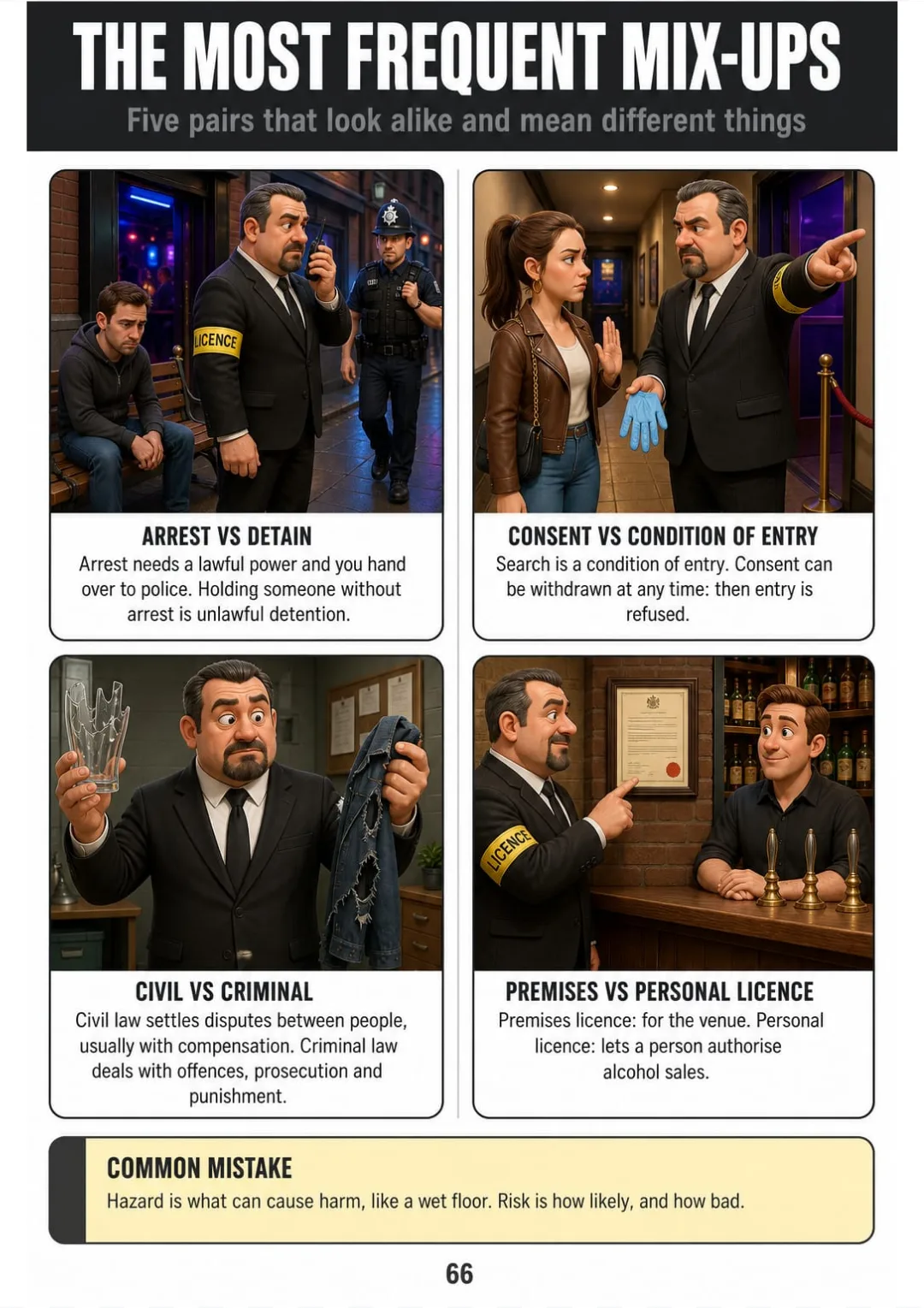
Arrest vs detain, consent vs condition, civil vs criminal, two licences, hazard vs risk.

Swipe to see more · tap to zoom →

The rules aren’t the hard part. The manual is.

In class the trainer says ‘detain’ and you write down ‘arrest’. Arrest, detain, restrain: three legal words, one blurred idea in your notes.

A customer at the door refuses the search. Can you hold him? Can you search anyway? No consent, no search — you refuse entry. The rule is on page 32, but in the manual it’s buried in a paragraph of conditions.

The manual gives you a paragraph of legal English for every rule. No scene at the door. No picture of who stands where.

You highlight, re-read, highlight again — and the definitions still slide off the page.

Arrest vs detain, consent vs condition, civil vs criminal, two licences, hazard vs risk.

This page puts the words people mix up side by side: arrest versus detain, consent versus condition of entry, civil versus criminal, hazard versus risk. Each pair drawn, each difference in one line.

When the words sit next to the scene, they stop blurring together.
COMPARE

The same topic studied two ways

INSTEAD OF THIS
  • Read a dense paragraph, try to memorise three stages in a list, hope you remember them tomorrow.
  • Highlight the page, cover it, test yourself, forget half of it by the next chapter.
  • Search YouTube for ‘citizen’s arrest door supervisor’ and get ten videos saying ten different things.
Upon effecting a citizen’s arrest pursuant to Section 24A of the Police and Criminal Evidence Act 1984 (PACE), the person effecting such arrest is obligated to inform the arrested individual of the grounds for arrest at the earliest practicable opportunity. The police must be contacted without unreasonable delay and the arrested individual’s safety and welfare maintained throughout the detention period. Force must not exceed that which is reasonable and proportionate in the circumstances as adjudged by the common-law test. A contemporaneous written record must include the precise time and location, the grounds relied upon, descriptions of force employed, the proportionality assessment and witness identification details.
CHOOSE THIS
  • Open the page: three stages drawn in order, each one a scene at the door.
  • See the whole sequence in one picture — the words sit next to the action.
  • One source, checked against UK legislation such as PACE 1984 and the SIA’s published door supervisor specifications, in the same order as your course.
After an arrest: tell them why, call police, keep them safe, hand over, write it up.
CONTENTS

Take a look: 7 parts, 64 topics

The full contents: seven parts in the order your course teaches them, each topic with its page number.

IBefore you start: the licence and the four units · pp. 5-10
  1. How to read this book
  2. The four units on one map
  3. What the SIA is and why it exists
  4. Your licence: what it lets you do
  5. Working without a licence
  6. The standards you are held to
IIUnit 1: Working in private security · pp. 11-24
  1. Civil law and criminal law
  2. Equality at the door
  3. CCTV, notes and personal data
  4. Health and safety: your duty too
  5. Hazard, risk and risk assessment
  6. Reporting accidents
  7. The fire triangle
  8. Fire extinguishers by colour
  9. Emergencies and evacuation
  10. Radio talk and the phonetic alphabet
  11. Terrorism threat levels
  12. Suspicious items: the HOT principle
  13. Run, Hide, Tell
  14. Spotting people at risk
IIIUnit 2: Your powers – arrest, force and searching · pp. 25-34
  1. You have no special powers
  2. Asking someone to leave
  3. Arrest by any person: England and Wales
  4. Arrest in Scotland and Northern Ireland
  5. Arrest, detain, restrain: three different words
  6. After an arrest
  7. Reasonable force
  8. Searching only with consent
  9. How to search: the routine
  10. What you find during a search
IVUnit 2: Licensing law, drugs and incidents · pp. 35-46
  1. The licensing objectives: England and Wales
  2. Scotland's fifth objective
  3. Premises licence, personal licence, DPS
  4. Drunk customers and the law
  5. Age checks and accepted ID
  6. Refusing entry with reasons
  7. Controlled drugs and the venue
  8. Preserving a crime scene
  9. Continuity of evidence
  10. Notebooks and incident reports
  11. Queues and crowd safety
  12. Closing time and dispersal
VUnit 3: Conflict management · pp. 47-55
  1. Why conflict starts at the door
  2. The attitude-behaviour cycle
  3. Reading warning signs
  4. Dynamic risk assessment
  5. Distance and position
  6. Words that calm
  7. Non-verbal communication
  8. Problem solving at the door
  9. After the incident
VIUnit 4: Physical intervention – the written side · pp. 56-62
  1. Physical intervention as a last resort
  2. Non-restrictive and restrictive
  3. Risk factors in a restraint
  4. The danger of the floor
  5. Signs of a medical emergency
  6. Communicating during an intervention
  7. Recording use of force
VIIExam week: review and checklists · pp. 63-68
  1. Your powers on one page
  2. The four nations at a glance
  3. Numbers and lists to know
  4. The most frequent mix-ups
  5. How the exam questions are worded
  6. The night before and the morning of

The door, seen from above, with the rule beside it.

The rule sits next to the scene. You see the door from above: where you stand, the gap between you and the customer, your hands. No paragraph to decode.

A top-down plan of the door: reactionary gap, angle, open hands and exit.

This page shows the reactionary gap from a top-down view. Your position, your angle to the customer, open hands — all drawn on one page with the rule in plain English beside it.

The picture stays with you. When you revise, you check the drawing, not a paragraph.

What's inside Door Supervisor Exams, Scene by Scene

Ipp. 5-10

Before you start: the licence and the four units

Open page 5 and see how every page works: the scene on the left, the rule on the right, the key legal word underlined. Page 6 maps all four units so you know where each topic sits.

IIpp. 11-24

Unit 1: Working in private security

Turn to page 18 and match every fire extinguisher by colour in one glance. Page 22: the HOT principle for a suspicious item drawn as a three-step check.

IIIpp. 25-34

Unit 2: Your powers – arrest, force and searching

Page 30: after an arrest, three stages drawn in order — explain, call, hand over. Page 32: searching only with consent, and what you do when someone says no.

IVpp. 35-46

Unit 2: Licensing law, drugs and incidents

Page 41: controlled drugs — Class A, B, C — bagged and logged on one page. Page 38: drunk customers and the law, drawn at the bar.

Vpp. 47-55

Unit 3: Conflict management

Page 51: the reactionary gap drawn from above — where you stand, your angle, your hands. Page 49: reading the warning signs before they say a word.

VIpp. 56-62

Unit 4: Physical intervention – the written side

Page 59: why face-down restraint is the most dangerous moment, and the signs to watch for. Written knowledge only: what the exam covers, not techniques to practise alone.

VIIpp. 63-68

Exam week: review and checklists

Page 66: the mix-ups that catch people — arrest versus detain, consent versus condition of entry — each pair drawn side by side. Page 67: how exam questions are worded.

Plus, 2 free books come with it

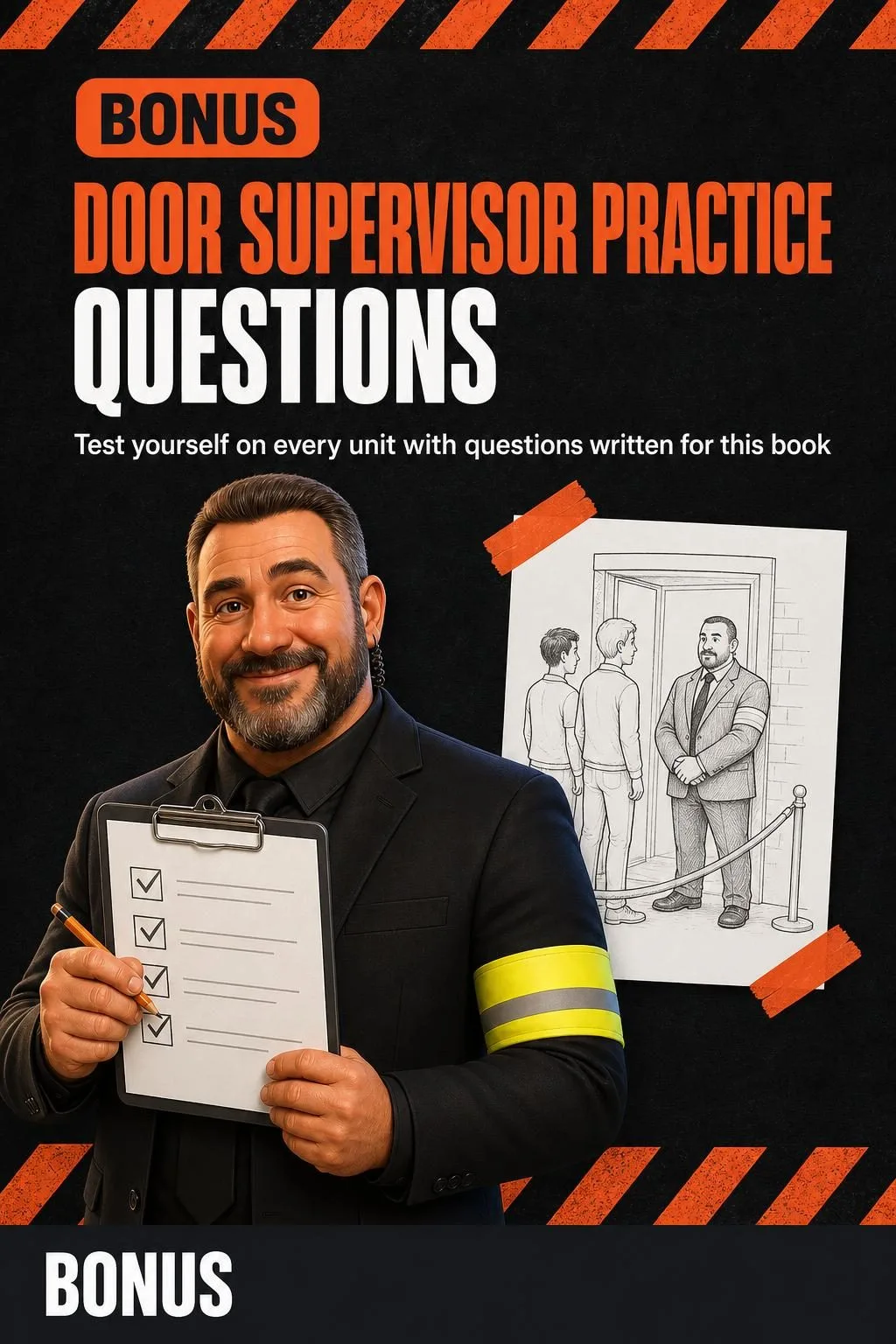
Door Supervisor Practice Questions

GIFT 1: «Door Supervisor Practice Questions»

Bought separately: US$ 17.90

Test yourself on every unit with questions written for this book, each answer explained with the page it comes from.

The Door Legal Words Book

GIFT 2: «The Door Legal Words Book»

Bought separately: US$ 14.90

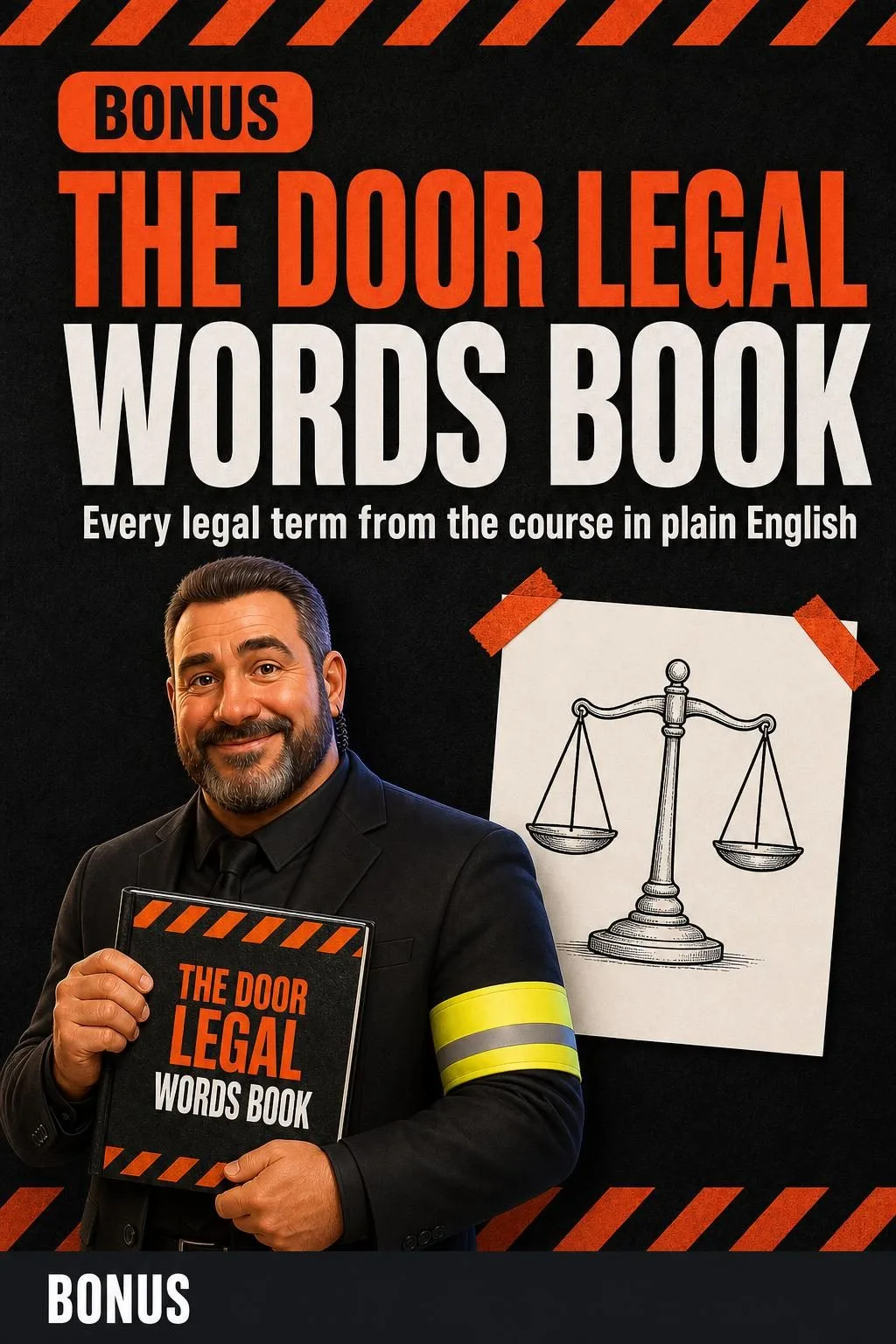
Every legal term from the course in plain English, with the mix-ups people make most often so you stop confusing them.

Your bundle: Door Supervisor Exams, Scene by Scene and 2 gifts

  • Door Supervisor Exams, Scene by Scene: 64 illustrated pagesUS$ 63
  • GIFT 1: Door Supervisor Practice QuestionsUS$ 17.90
  • GIFT 2: The Door Legal Words BookUS$ 14.90
  • High-quality PDF file, ready to printIncluded
Total value US$ 95.80
BUNDLE PRICE
US$ 27
YOU SAVE: US$ 68.80
GET DOOR SUPERVISOR EXAMS, SCENE BY SCENE · US$ 27

📄 Digital book in PDF: it comes by email. Nothing is shipped on paper.

Protected paymentEncrypted data30-day guarantee

PDF by email: You receive Door Supervisor Exams, Scene by Scene as a PDF in your inbox, along with the 2 free books. You pay once: no installments, no extra charges.

Who picks up this book

Course booked, exam soon

Course booked, exam soon

You’re coming from hospitality, driving, construction or the forces. The legal language is new, the exam is soon, and you need to see the rules — not just read them.

English isn’t your first language

English isn’t your first language

You live and work in the UK but the manual’s legal terms are hard enough without dense paragraphs. Every word here is drawn beside a scene, in plain English.

Revising or resitting a unit

Revising or resitting a unit

You’ve done the course or failed a module. You need a faster way to go through the four units without reading the whole manual again.

Everything your purchase includes

US$ 95.80US$ 27
GET DOOR SUPERVISOR EXAMS, SCENE BY SCENE · US$ 27

📄 Digital book in PDF: it comes by email. Nothing is shipped on paper.

30DAYS
GUARANTEE

30 days to try it

100% money-back guarantee for 30 days. Use it alongside your course revision. If it doesn’t help you understand the four units, tell us what didn’t work and we’ll refund every penny.

Common questions

Is it a physical book or digital?

It’s a digital PDF sent by email. You can read it on any screen or print it at home.

Can I read it on my phone?

Yes. Every page is designed to be clear on a phone screen.

Where do the files arrive?

At the email address you enter when you pay: the main book and both bonus books, as PDFs.

Is this an official SIA product?

No. This is an independent illustrated study guide. It is not produced, endorsed or affiliated with the Security Industry Authority or any awarding organisation, and it does not give you a certificate or a licence — those only come from your approved course and exams.

Does it replace the training course?

No. The mandatory classroom course and practical assessment are still required. This guide is a revision companion to help you understand and remember what the course covers.

Does it cover Scotland and Northern Ireland?

Yes. Where the law differs — arrest powers, licensing objectives — the difference is marked on the page where it applies.

Will I be charged again later?

No. It’s a single payment for the book and the two bonus books, sent as PDFs by email. Nothing renews.

I’m just starting — will I understand it?

Yes. Every topic follows the course order, each rule is in plain English, and every legal word is explained beside a drawing.

My English isn’t perfect. Is it still for me?

Yes. The language is simple and clear. Legal terms are drawn next to their meaning, so you see the word and the scene together.

Before you close this page

You’ve already paid for the course. You’ve already booked the days off work.

This book puts the law in pictures so you walk into the exam room knowing what each rule means and where it applies.

One read. Every rule drawn at the door.

Open the first page. See the door before you sit the exam.

US$ 27, paid once · 30-day guarantee · PDF by email

GET DOOR SUPERVISOR EXAMS, SCENE BY SCENE · US$ 27

📄 Digital book in PDF: it comes by email. Nothing is shipped on paper.